At a glance
- Confirm the exact KATO model before comparing tyre or wheel options.
- Check the tyre size alongside the load rating, speed rating, and construction.
- Check wheel fitment against PCD (pitch circle diameter), centre bore and offset, not just stud count.
- Check tyre size and stud pattern separately, since they relate to different parts of the fitment.
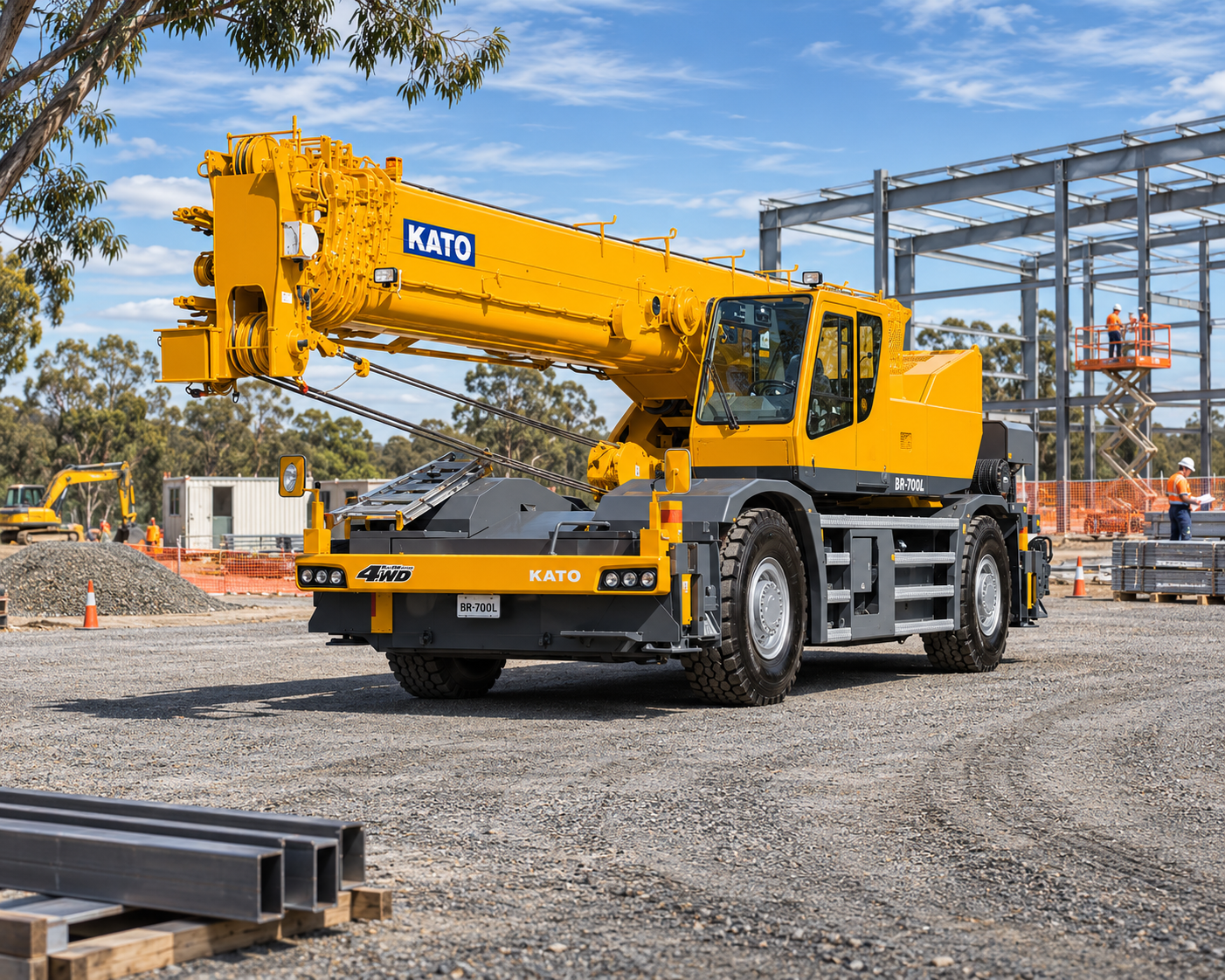
Finding a replacement tyre for a KATO crane requires more than matching the crane brand or tyre size. Different KATO models can have varying tyre sizes, load capacities and wheel configurations, meaning a tyre that appears suitable may not actually be compatible with the crane.
Tyre size and wheel stud pattern relate to different aspects of fitment, and both should be verified before ordering. Matching the tyre size alone does not confirm that the wheel and mounting configuration are compatible with the crane.
This is why you need to know which specifications to check and how to source a suitable replacement in Australia. Here’s what to check on KATO crane tyre sizing, stud patterns, fitment and sourcing so you can identify the right requirements before ordering.
KATO Crane Tyre Sizing and Stud Patterns: What Needs to Match?
Before ordering a replacement, confirm the key specifications that determine whether the mobile crane tyre and wheel are suitable for your crane. Here are the key details to check before approaching a supplier:
Start With the Exact KATO Crane Model
The manufacturer name alone is not enough to identify a correct replacement. KATO produces a range of crane models across different generations, with tyre and wheel requirements varying between models. Quoting only “KATO” to a supplier leaves too much room for a mismatch, particularly where older or less common models are involved.
Record the full model or model code rather than a general description. This information is usually available on the crane’s identification plate, in the equipment manual or from records kept for the machine. Having this on hand before you start comparing tyre or wheel options makes the rest of the process more straightforward.
Confirm the Complete Tyre Size From the Sidewall
Once you’ve confirmed the crane model, check the tyre sidewall for its full size marking. For example, a marking such as 385/95R25 contains several important details: 385 indicates the tyre width in millimetres, 95 is the aspect ratio, “R” indicates radial construction and 25 refers to the rim diameter in inches. Each part helps determine whether the tyre is suitable for the crane.
Also, check whether the existing tyre uses radial or bias construction. Tyres with similar dimensions can have different constructions and are not automatically interchangeable.
Confirming the complete marking and construction gives a supplier the information needed to identify a suitable replacement.
Check Load Capacity and Speed Rating Alongside Size
Matching the nominal size is only one part of a complete specification. Two tyres of the same size can have different load indices, meaning one may not provide sufficient capacity for your crane even though the dimensions match. This matters directly for a crane tyre replacement, since undersized load capacity affects how the tyre performs under the crane’s actual working conditions.
Speed rating deserves the same attention. Mobile cranes often travel between worksites under their own power, so the replacement tyre needs a speed capability suited to that travel, not just to the crane’s lifting operations. That’s why you should check load index and speed rating together with size, giving you a fuller and more reliable specification to work from.
Understand the Difference Between Tyre Size and Stud Pattern
Tyre size and stud pattern cover two separate parts of the fitment, and it helps to be clear on the distinction before you contact a supplier. Confirming one does not automatically confirm the other, so you need to check both independently for complete tyre and wheel fitment.
- Tyre sizing determines whether a tyre is compatible with a given rim, covering dimensions such as width, aspect ratio and rim diameter.
- Stud pattern determines whether the wheel is compatible with the crane’s hub.
- Stud pattern is a wheel specification rather than a characteristic of the tyre itself.
Verify More Than the Number of Wheel Studs
Stud count is a useful starting point, but it does not establish fitment on its own. Two wheels can share the same stud count while differing in other respects that determine whether they will actually fit the crane’s hub arrangement.
The wheel must match the hub in key areas, including its pitch circle diameter (PCD), centre bore and offset. Its rim diameter and width must also be compatible with the selected tyre. Consider these measurements together rather than relying on the number of studs alone. This gives you a complete wheel specification to provide to your supplier.
How to Source KATO Crane Tyres in Australia
With the exact specifications confirmed, the next step is to find a supplier who can meet them accurately.
- Start with specialist crane tyre suppliers: General tyre retailers may not stock or understand KATO applications the way a specialist supplier does. A supplier familiar with heavy-duty crane tyres is more likely to recognise your specifications and have suitable options available through their existing network.
- Look for access to international supply networks: Some KATO tyre sizes, particularly on older or less common models, are not always available within Australia. A supplier with established overseas connections can still track these sizes down when local stock falls short.
- Ask about equivalent replacement options: If the original specification is unavailable, an experienced supplier may be able to identify a suitable equivalent from another manufacturer. This keeps the crane operational without compromising on load capacity or fitment accuracy.
- Confirm lead times and delivery coverage: Once you’ve identified a suitable crane tyre, check stock status and expected lead time. Check whether delivery reaches your workshop, depot or operating location, particularly in areas outside major metro areas.
There is no single tyre or wheel specification that suits every KATO crane. Correct selection starts with the exact crane model and a complete tyre specification, including size, construction, load index and speed rating. If you’re also replacing the wheel, check stud count alongside PCD, centre bore, offset, rim diameter and width. Once you’ve confirmed these details, sourcing depends on availability rather than guesswork.
As a trusted tyre and wheel supplier, Oceanic Direct can help you source the right replacement once your specifications are confirmed. Share your mobile crane model, tyre markings and wheel details, and our team will help identify suitable tyre or wheel options for your crane. Get in touch to get started.
FAQs
How do I identify my KATO crane model if the tyre information is no longer readable?
Check the crane identification plate, operator manual or service records for the full KATO model or model code. If these are unavailable, a specialist supplier may also help identify the crane using equipment photos and existing wheel details.
Can replacement wheels be made for older KATO cranes?
Yes, replacement wheels may be custom-made for older KATO cranes when the original specification is obsolete or difficult to source.
Why do load index and speed rating matter when choosing a crane tyre?
Load index indicates how much weight a tyre can support, while speed rating shows the maximum speed it is designed to handle. Checking both tyre load and speed ratings against the crane’s actual operating conditions, rather than assuming they match, avoids under-specifying either.
Related Stories
How to Choose the Right Tyres for Your Franna Pick & Carry Crane
At a glance Tyre size alone does not confirm the suitability of Franna pick & carry cranes. Inspect load and speed ratings to reflect both pick-and-carry work and regular road travel. Check creep data for ...
What Makes Mobile Crane Tyres Different From Standard Truck Tyres?
At a glance Mobile crane tyres are designed to support heavy machine weight and worksite stability, not freight transport. Reinforced sidewalls, strong casing construction and versatile tread patterns help crane tyres perform across both roads ...
Related Posts