

At a glance
- Your truck’s existing hub determines whether it needs a 6-Stud, 8-Stud or 10 Stud super single wheel.
- Matching the stud count alone is not enough; PCD, centre bore and offset must also align.
- Wheel and tyre dimensions, axle loads and component clearance all influence final fitment.
- Accurate vehicle and wheel details help prevent unsuitable choices and delays during a custom conversion.
When comparing super single wheel options, the number of studs is one of the first things that determines which wheel your truck needs. A 6-Stud, 8-Stud or 10 Stud description is not a style preference or a size category. It reflects how the wheel physically mounts to your truck’s hub.
Because the correct configuration depends on your vehicle itself, choosing the wrong stud pattern is not simply an inconvenience. It can rule out an otherwise suitable wheel entirely.
Stud count is only the first detail to confirm. Centre bore, pitch circle diameter (PCD), offset, wheel dimensions, load rating and clearance around surrounding components all need to line up as well.
This blog covers what 6-stud and 8-10 stud super single wheels mean and how they compare across common truck types, then explains what to check before requesting a conversion for your vehicle.
What Do 6-Stud, 8-Stud or 10 Stud Super Single Wheels Mean?
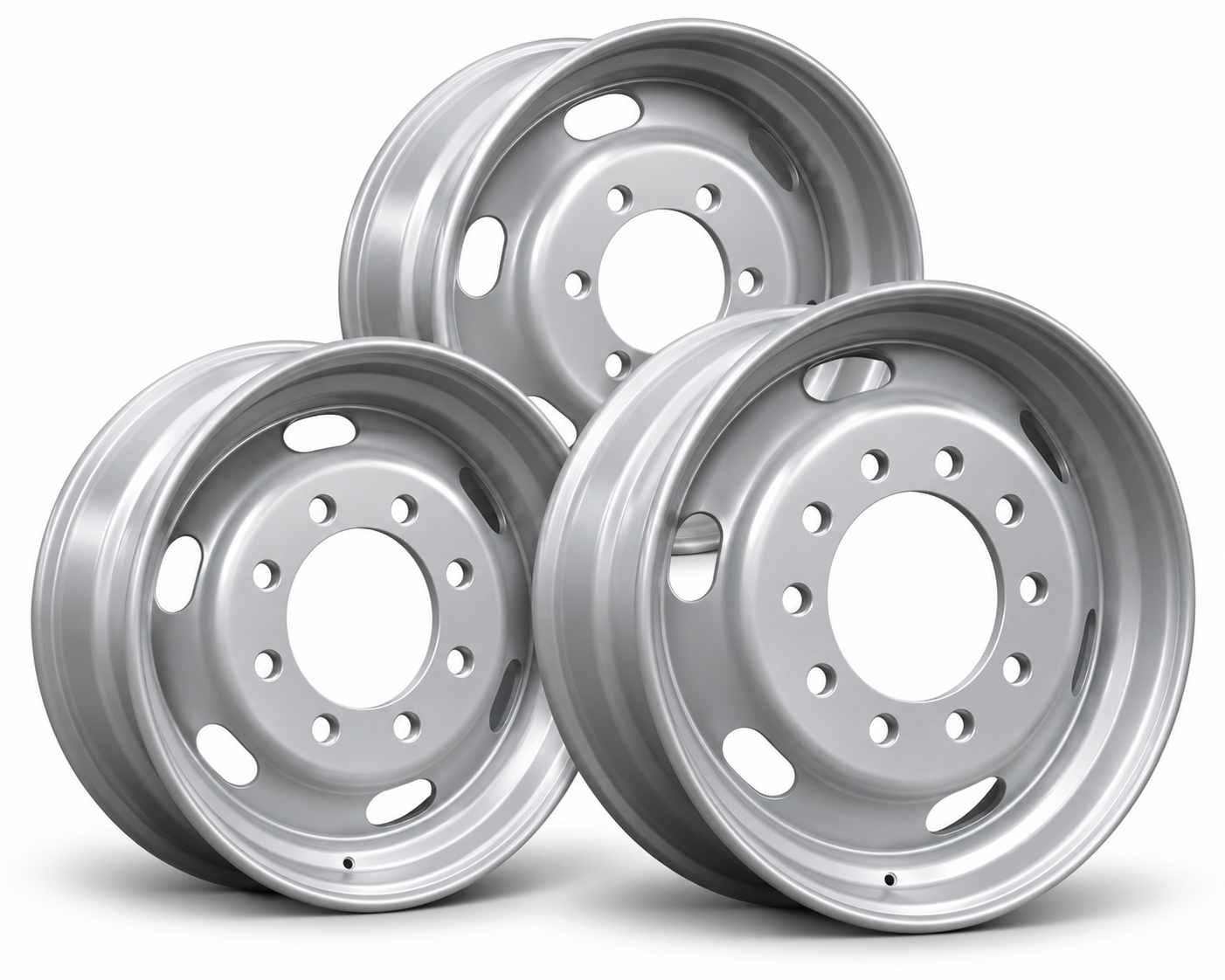
A 6-stud wheel attaches to a hub through six wheel studs or mounting holes. Certain light- and medium-duty Japanese trucks use this configuration, including selected Isuzu, Hino and Mitsubishi Fuso models. A truck with a 6-stud hub generally requires a compatible 6-stud wheel, though the exact PCD, centre bore and other dimensions still need to be confirmed before ordering a wheel.
An 8-stud wheel uses eight mounting positions and is designed for a corresponding 8-stud hub arrangement. This configuration also appears across Isuzu, Hino and Mitsubishi Fuso ranges, typically on larger or heavier truck models than those commonly fitted with a 6-stud hub.
An 10-Stud Wheel: Standard on heavy-duty commercial trucks, prime movers, and large semi-trailers. This configuration handles massive torque, heavy payloads, and high-stress industrial applications
Having more studs does not automatically make a wheel the better option. The correct configuration still depends on your truck’s existing hub, not the stud count on its own.
The difference between 6-Stud, 8-Stud or 10 Stud super single wheels starts with the hub’s mounting pattern, which determines which wheel can physically be fitted. From there, the two configurations also tend to differ in wheel diameter, operating role and clearance requirements, as set out below.
| Practical Consideration | 6-Stud Super Single Wheels | 8-10 Stud Super Single Wheels |
| Typical wheel diameter offered | Commonly available in 19.5-inch super single conversions | Commonly available in 22.5-inch super single conversions |
| Typical operating role | Often suited to courier, trade and regional delivery work | Often suited to higher-capacity regional or interstate transport work |
| Wheel and tyre assembly weight | Generally lighter, suited to lighter-duty platforms | Generally heavier, suited to heavier-duty platforms |
| Clearance considerations | Usually sits within your truck’s original wheel envelope | Larger diameter may require extra clearance checks around brakes, suspension and guards |
Which Stud Configuration Does Your Truck Need?
Knowing the difference between 6-Stud, 8-Stud or 10 Stud super single wheels is only the first step. Determining which configuration your truck needs involves a few key checks, starting with the basics and moving through to the details that determine fitment.
Start With Your Truck’s Exact Vehicle Details
Before anything else, record the exact details of your vehicle: make, full model, series, year and drive configuration (e.g., 4×4 or 6×4). It’s tempting to assume the manufacturer’s name tells you enough, but trucks from the same brand often run different hubs, axles and wheel arrangements depending on the model and year.
These details give a supplier a reliable starting point for narrowing down whether your truck is likely to need a 6-stud super single wheel or an 8-stud super single wheel. Skipping this step slows down a truck super single conversion later, since guesswork at this stage needs correcting once the order is underway.
With the vehicle identified, the next step is confirming what’s actually on the hub.
Confirm the Existing Stud Count and Hub Pattern
This step answers the 6-Stud, 8-Stud or 10 Stud question directly. Count the wheel studs or mounting holes on your truck’s current wheel to establish the base configuration. Then, confirm the PCD, since two wheels with the same stud count can still place those studs on different diameter circles. This detail matters just as much as the stud count for a super single wheel conversion.
Take note of the centre bore, the stud-hole design and the wheel-nut type as well, because these affect how the wheel centres and mounts, not just whether it lines up with the studs. Completing this step correctly helps rule out incompatible wheels early, before you spend time comparing options that are not suitable for your truck.
Record the Current Wheel and Tyre Dimensions
You need accurate current measurements at this stage, rather than estimates based on appearance. These figures matter just as much as the stud pattern when narrowing down a suitable replacement.
- Current wheel diameter and width, taken directly from the wheel.
- Tyre width, aspect ratio and rim diameter, as shown on the sidewall.
- Any additional size markings specific to the current wheel or tyre.
Stud count determines whether a wheel can be mounted on the hub at all. The current dimensions serve a different purpose, narrowing the range of super single wheels for trucks with a comparable footprint to the one being replaced.
The hub and tyre size alone don’t determine fitment. The space surrounding the wheel matters just as much in the decision.
Check Offset, Track Position and Component Clearance
Confirm the wheel offset or inset required to position the wheel and tyre correctly relative to the hub, chassis and bodywork. Then check the clearance around the brakes, suspension, steering components and guards across your vehicle’s full range of movement, not just when it’s sitting still.
Also determine whether your truck needs a vehicle-specific reversible wheel to support the correct front and rear track arrangement. A wheel can match the stud pattern perfectly and still be the wrong choice if it positions the tyre incorrectly or makes contact with nearby components once your truck is in motion.
Match the Wheel to Axle Loads and Operating Conditions
Your truck’s front and rear axle load requirements matter just as much in this decision as size does. Confirm those figures directly, then match both the wheel and tyre load ratings to the relevant axle position and intended payload. Custom super single wheels suited to one axle position won’t necessarily suit another on the same truck.
Also consider where your truck spends most of its time. Whether it operates on highways, worksites, sand, mud or corrugated roads, the environment shapes what custom-made super single wheels need to handle day to day.
A wheel that fits the hub and carries the right load is only the right choice once it also suits how your truck is used, whether you choose a 6-Stud, 8-Stud or 10 Stud configuration.
Choosing between 6-Stud, 8-Stud or 10 Stud super single wheels depends on the mounting pattern already fitted to your truck, not personal preference or wheel size. A 6-stud hub requires a 6-stud wheel, while an 8-stud hub requires an 8-stud wheel, but stud count is only the starting point.
You must also confirm PCD, centre bore, wheel dimensions, offset, load rating and clearance before a wheel is a genuine fit. Gathering these details before requesting a conversion helps identify a wheel suited to your vehicle and its operating requirements.
If you are ready to explore a super single wheel conversion, Oceanic Direct, an established provider of super single wheels, can help you source a custom-made wheel matched to your truck’s stud pattern, dimensions and operating requirements. Contact us with your vehicle, wheel and tyre details to confirm the right configuration.
FAQs
Will a super single conversion change the spare wheel setup I need?
It may. The original spare may not match the new wheel diameter, tyre size, offset or stud pattern, while some reversible super single wheels can be used on both front and rear axles. Confirm the spare-wheel arrangement when specifying the conversion.
Should wheel studs and nuts be inspected during a super single conversion?
Yes. Inspect wheel studs and nuts during a super single conversion to check thread engagement, look for corrosion or elongation and verify correct hardware compatibility.
What details should I provide when ordering custom super single wheels?
Provide your truck’s make, model and year, along with the current tyre size, existing wheel specifications and any relevant hub measurements. See our guide on ‘information required for made-to-order super single wheels’ for a complete checklist before placing an order.
Related Stories
Guide for Selecting Best Rims For Your ATV, Quad, and Dirt Bike Tyres
A rim of any vehicle is the outer edge of a wheel that holds the tyre firmly in place so that the tyre rotates in conjunction with the wheels. Rims can have different designs, widths, ...

Increasing Dependence On Logistics Via Trucks – What Does It Mean?
Our Increasing Dependence On Logistics Via Trucks Instead Of Air Freight – How Is This Impacting Our Need For High-Quality Truck Tyres And Rims? The transportation and logistics industries are some of our most vital ...
Related Posts


Essential Tyre Safety Checklist for Your Next Road Trip
With over 30-year experience as an importer, wholesaler, and retailer of wheels and tyres in Australia, we at Oceanic Direct know how quality tyres and wheels play a crucial role in providing you and your ...