

At a glance
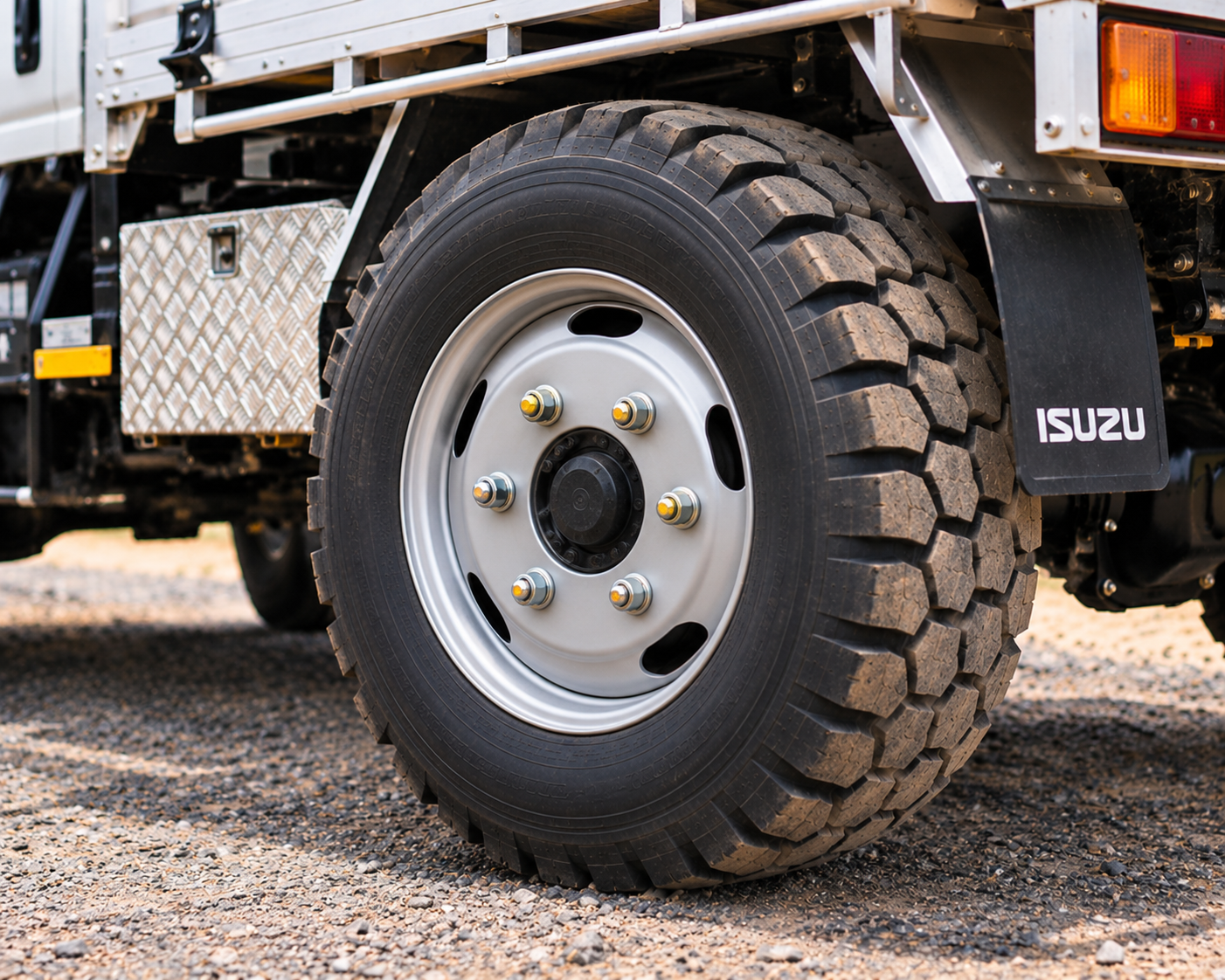
- 6-stud Isuzu, Hino and Mitsubishi trucks can be converted to super singles.
- Wider tyres can improve stability across rough and uneven terrain.
- Matching wheel tracks can support better handling on soft ground.
- Accurate vehicle and wheel details help ensure the right conversion setup.
Many Isuzu, Hino and Mitsubishi trucks come fitted with dual rear wheels as standard. This arrangement performs well for everyday local and regional road use, where surfaces are generally predictable. Owners who operate these trucks across sand, mud, corrugations or rough terrain often look for wider wheel and tyre setups better suited to those conditions.
If that sounds like your operation, one question naturally follows. Can a 6-stud Isuzu, Hino or Mitsubishi truck be converted from dual wheels to super singles?
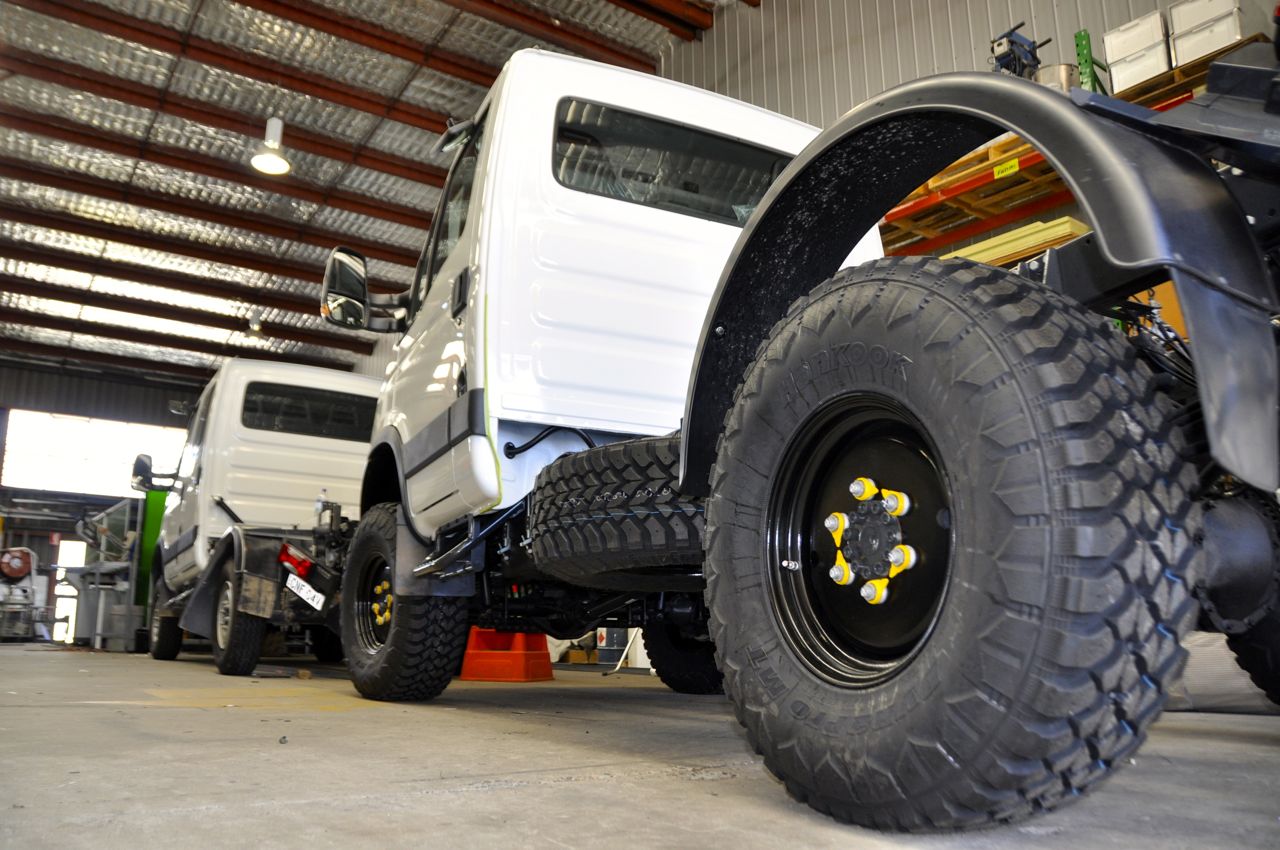
Yes. Oceanic Direct offers custom-made 6-stud steel super single wheels, paired with matching heavy-duty tyres, for Isuzu, Hino and Mitsubishi trucks. Here’s what the conversion involves, the benefits of switching to super singles and what you’ll need to order one.
What Does a Super-Single Conversion Involve?
A 6-stud super-single conversion involves several coordinated changes to your truck’s wheel setup, rather than simply fitting a wider tyre. These include:
- Replacing the rear dual-wheel arrangement: On each side of the truck, the two narrower rear wheels are removed and replaced with a single wider wheel and tyre, moving the truck from a dual-wheel setup to a super-single configuration.
- Fitting wider super-single tyres: The new wheels are paired with heavy-duty super-single tyres sized for the wider single-wheel arrangement. Tyre selection is based on the loads the truck carries and its intended application, rather than simply matching the original dual tyre size.
- Setting the wheel offset for the front and rear: The offset on the new wheels can be set so the front and rear wheels sit on the same outside line, allowing the rear tyres to track more closely behind the front tyres.
- Moving to a purpose-built single-wheel configuration: Once these changes are complete, your truck runs on a dedicated super-single setup rather than a modified dual arrangement, with the wheel and tyre specifications matched to your vehicle from the outset.
What Are the Benefits of Switching to Super Singles?
The wider tyre and revised wheel configuration can affect how your truck handles and performs across different operating conditions. Key benefits include:
A Wider Footprint Can Improve Stability and Manoeuvrability
A super-single tyre puts a wider footprint on the ground than the narrower tyres in a standard dual arrangement, which can support greater stability as conditions change from sealed roads to loose or uneven ground. It can also improve manoeuvrability away from regular sealed-road surfaces.
On sand, gravel or corrugated tracks, that added stability can make handling more predictable, particularly in tighter spaces or on uneven worksites.
Matching the Front and Rear Wheel Tracks Helps on Soft Terrain
Setting the front and rear wheels to the same track means the rear wheels follow closely behind the path the front tyres have already made.
Rather than cutting a separate line through the ground, the rear wheels move through terrain the front axle has already compacted.
This consistent wheel path is particularly useful on soft or shifting ground such as mud, clay or sand, where predictable turning matters more than it does on a sealed road.
Increased Wheel Diameter Can Improve Fuel Efficiency
The wheels used in a super-single conversion have a larger rolling diameter than the original dual wheels. A larger diameter means each full revolution covers more ground, which changes how the engine works to maintain a given road speed.
Over regular on-road distances or a mix of on-road and off-road running, this can contribute to a more efficient setup overall. For trucks covering long or repeated routes, small gains per revolution can add up over time.
Super Singles Can Support Longer Tyre Life
A well-matched super-single wheel and tyre combination can support a longer tyre life than a standard dual setup, particularly for trucks operating in demanding conditions. Reduced strain across a wider, properly loaded tyre can help slow the wear that comes with heavy or repeated off-road use.
For example, if you regularly run gravel roads or corrugated tracks, dual tyres can wear unevenly as stones and debris get trapped between the pair, while a single wider tyre avoids that particular cause of wear.
Selecting tyres suited to the intended application, rather than defaulting to a generic size, plays a large part in this. When the wheel and tyre combination is built around how your truck is used, durability tends to hold up better over time.
What Information Is Required to Order a 6-Stud Super-Single Conversion?
Providing accurate vehicle and wheel information helps identify the appropriate conversion setup. Start with the following details:
- Vehicle make: Confirm whether your truck is an Isuzu, Hino or Mitsubishi, as this determines which conversion specifications apply to the enquiry.
- Model and year: Provide the exact model and year of your vehicle so we can identify and match the correct wheel configuration.
- Current tyre size: Record the tyre size currently fitted to your truck, so we can confirm the existing wheel-and-tyre arrangement before quoting.
- Current wheel specifications and measurements: Supply the measurements and mounting details of your current 6-stud wheels, including PCD, centre bore, nut type and stud-hole type.
No need to guess at these figures.
Oceanic Direct’s wheel measurement guide shows you exactly how to record the PCD, centre bore, nut type and stud-hole details before you submit your enquiry. This helps reduce delays caused by incomplete or incorrect measurements during the ordering process.
Isuzu, Hino and Mitsubishi trucks with 6-stud wheels can be converted from duals to purpose-built super singles using custom-made steel wheels and heavy-duty tyres. This setup can improve stability, handling on soft terrain, fuel efficiency and tyre life. To get started, record your vehicle and current wheel details using the measurement guide before contacting the supplier.
If you are planning a 6-stud super-single conversion, partner with Oceanic Direct, a trusted custom truck wheel supplier in Australia, to get custom-made wheels and heavy-duty tyres matched to your truck. Get in touch with us today to discuss your requirements and find the right conversion setup for your truck.
FAQs
What wheel and tyre sizes are available for a 6-stud super-single conversion?
Oceanic Direct offers custom-made 8.25 × 19.5 6-stud steel super-single wheels, including curved-centre and flat-plated-centre designs, paired with suitable heavy-duty super-single tyres. Explore the 6-stud super-single wheel conversion range.
Can you use the existing wheel nuts with a 6-stud super-single conversion?
Yes. Oceanic Direct’s 6-stud super-single conversion is designed to reuse your vehicle’s existing wheel nuts, so you don’t need separate replacement nuts for this setup.
What is the difference between a truck wheel, rim and disc?
The rim is the outer section that supports the tyre, while the disc connects the rim to the vehicle hub. Together, they form the complete wheel assembly. Terms such as PCD, centre bore and offset are also part of broader truck wheel terminology.
Related Stories
Guide for Selecting Best Rims For Your ATV, Quad, and Dirt Bike Tyres
A rim of any vehicle is the outer edge of a wheel that holds the tyre firmly in place so that the tyre rotates in conjunction with the wheels. Rims can have different designs, widths, ...

Increasing Dependence On Logistics Via Trucks – What Does It Mean?
Our Increasing Dependence On Logistics Via Trucks Instead Of Air Freight – How Is This Impacting Our Need For High-Quality Truck Tyres And Rims? The transportation and logistics industries are some of our most vital ...
Related Posts

Essential Tyre Safety Checklist for Your Next Road Trip
With over 30-year experience as an importer, wholesaler, and retailer of wheels and tyres in Australia, we at Oceanic Direct know how quality tyres and wheels play a crucial role in providing you and your ...