

At a glance
- Dual to super single conversions can be road legal in Australia when they meet applicable vehicle standards and approval requirements.
- Your truck’s gross vehicle mass (GVM) and registration jurisdiction determine which modification rules and approval processes apply.
- Check your tyre load ratings first, because converting from duals to singles can reduce the general mass limit for the axle.
- Wheel offset, tyre dimensions and mounting compatibility must be checked to ensure the converted truck remains compliant.
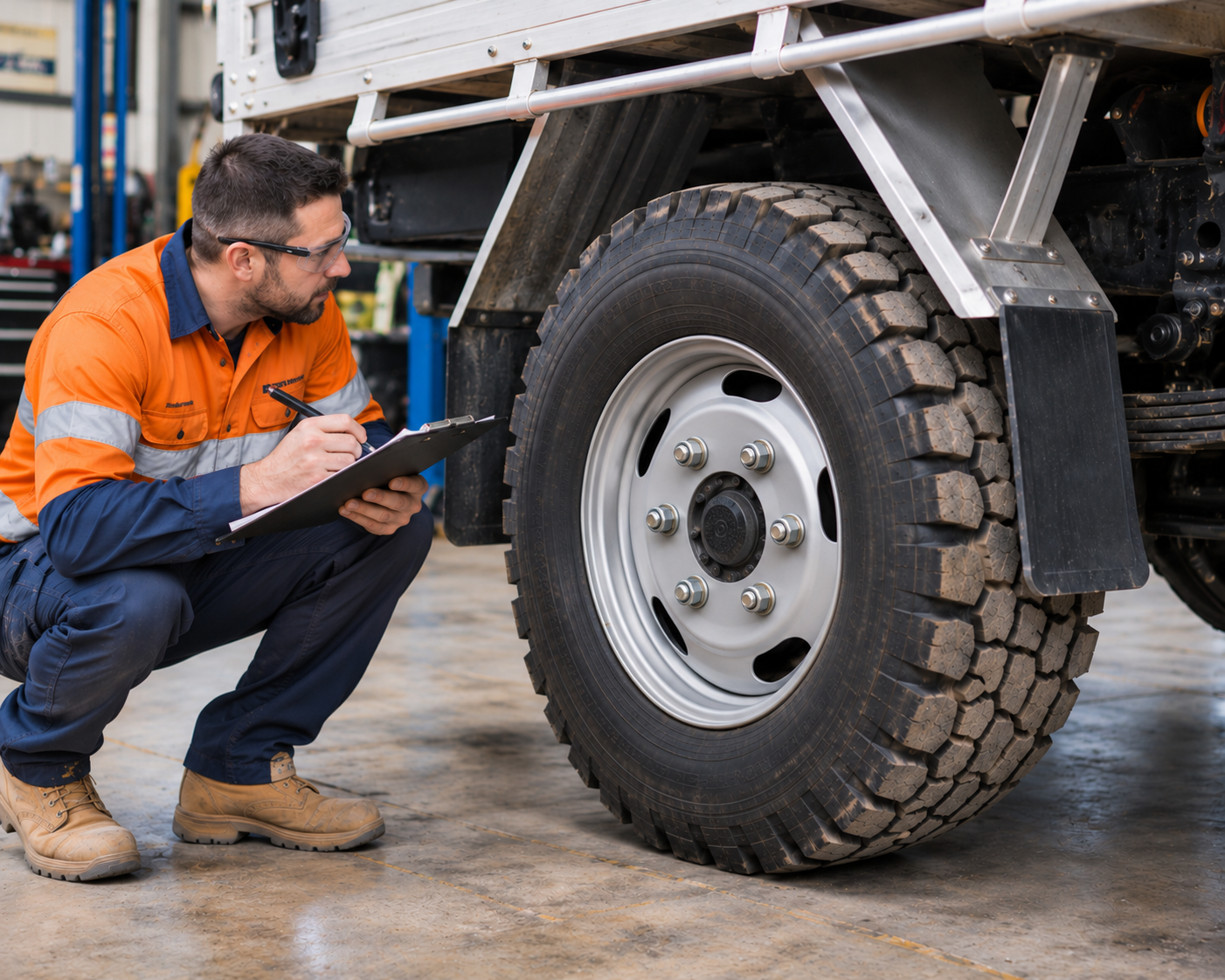
Converting a truck from dual wheels to super singles is not a simple wheel change. It is a vehicle modification, and it must meet Australian vehicle standards and road compliance requirements.
Swapping two narrower tyres for one wider tyre can affect axle loading, wheel track and overall dimensions. If those effects are overlooked, a truck may need rework or further certification before it is ready for public roads. Understanding the requirements early helps you avoid delays and unplanned costs.
Let’s look at the compliance rules, wheel and tyre requirements, load ratings, approval pathways and state or territory requirements that apply to a conversion. Because the exact requirements depend on your truck’s specifications, GVM and place of registration, check these details before you plan a conversion.
Are Dual to Super Single Conversions Legal in Australia?
Yes, a dual-to-super-single conversion can be legal in Australia, provided the modified truck still meets applicable vehicle standards and you obtain any required modification approval. The rules depend largely on the truck’s GVM and where it is registered.
For heavy vehicles over 4.5 tonnes GVM, the NHVR’s VSB6 is the main standard used to assess modifications. Under Modification Code D3, an Approved Vehicle Examiner (AVE) can certify non-standard rear wheel components, including dual-to-single conversions. This does not apply where the vehicle manufacturer prohibits the conversion.
If the conversion is within the manufacturer’s specifications, no modification approval is required. Otherwise, the AVE inspects the work and issues a modification certificate. For light vehicles up to 4.5 tonnes GVM, VSB14 Section LS sets the technical requirements.
Approval processes vary between jurisdictions, so confirm local requirements before you start. Western Australia and the Northern Territory run their own heavy-vehicle modification schemes. The NHVR notes that a modification authorised in either jurisdiction may still be recognised under the Heavy Vehicle National Law. This requires the vehicle to carry a VSB6 compliance plate or label.
What Compliance Requirements Must a Super Single Conversion Meet?
Super single conversion regulations in Australia focus on one question. Can the modified truck still operate within its ratings and applicable vehicle standards? The main truck wheel modification requirements fall into four areas:
Tyre and Wheel Load Ratings
In a dual to super single conversion, one tyre and wheel carries the load that two carried before. The replacement must be rated for the axle and the loads it is expected to carry.
For light goods vehicles originally fitted with duals, VSB14 requires the single tyre to be at least as wide as both original tyres combined. The single tyre’s load rating must also equal or exceed the combined rating of the original tyres. The only exception is fitting a complete single-wheel axle assembly from another vehicle.
Heavy vehicles must also comply with the NHVR’s general mass limits, which vary with tyre configuration and section width. Converting from duals to singles can therefore change what an axle may legally carry.
For example, a single rear axle has a general mass limit of 9.0 tonnes with duals. With single tyres, the limit is 6.0 to 7.0 tonnes, depending on section width. You also cannot exceed the manufacturer’s ratings for the tyre, wheel and axle.
Wheel Offset and Track Width
Wheel offset determines where the new wheel sits in relation to the hub. A changed offset can place more load on the outer wheel bearings, hub and axle, which may reduce the axle’s effective load rating. An unsuitable offset can also cause premature wear or failure of those components, so it needs assessing during the modification.
Track width also affects compliance. For heavy vehicles, a rear track change of more than 25 mm, or other differences from the manufacturer’s specification, makes the wheels non-standard. The rules for non-standard rear wheels then apply. For light goods and off-road vehicles, wheel track generally cannot increase by more than 50 mm beyond the manufacturer’s maximum.
Tyre Size, Diameter and Clearance
The wheel and tyre assembly must stay within the vehicle’s permitted dimensions. That means keeping inside the mudguards and the 2.5 metre maximum vehicle width, with clear space around the brakes, suspension and bodywork. Because a super single is wider than either tyre it replaces, confirm these clearances for your truck.
If the overall diameter changes, the speedometer and road speed limiter may need recalibrating so they remain accurate. The new wheel and tyre must also not affect advanced braking systems fitted to the truck, such as electronic stability control.
Wheel Mounting and Structural Compatibility
Compliance depends on more than whether the wheel bolts on. The vehicle must also be permitted to run single rear tyres. Confirm both points with your conversion specialist before ordering any wheels.
- The stud pattern and pitch circle diameter (PCD) must match the truck’s hub.
- The tyre and rim must be a recognised matched pair under Tyre and Rim Association of Australia standards, or an accepted alternative.
- Wheel spacers are not permitted unless the vehicle manufacturer allows them.
- Rims made specifically for a conversion should be tested to relevant standards.
- The vehicle manufacturer must not directly prohibit a dual to single conversion, because a prohibited conversion falls outside Modification Code D3.
What Information Should You Have Ready for a Super Single Conversion?
Gather these details before you start, so the right wheel and tyre combination can be identified and checked against the relevant rules.
| Information | What to provide and why |
|---|---|
| Vehicle details | Make, model, year and GVM (from the compliance plate). GVM shows which rules apply. |
| Current tyres | Front and rear tyre sizes (from the sidewall). These are the baseline for checking diameter and width. |
| Wheel specifications | Stud pattern, rim size, PCD and centre bore. These confirm the wheel will match the hub. |
| Axle and load details | Axle ratings and typical loads. Together they let you check load ratings against mass limits. |
| Registration and usage | State or territory, and whether the truck runs on-road, off-road or both. Requirements can differ. |
Tip: Not sure how to measure a wheel? Our wheel-measuring reference explains what to record. If a detail is hard to find, mark it as unknown rather than guess, because an estimated figure can lead to the wrong fitment.
Compliance depends on your truck’s GVM and state or territory of registration. It also depends on load ratings, wheel offset, track width, tyre dimensions and wheel mounting. Confirm any manufacturer restrictions and required certification early, so the conversion avoids rework later.
Planning a dual to super single conversion? Oceanic Direct can source custom super single wheels and tyres suited to your truck, load and route. Contact us with your truck’s make, model, current tyre size and wheel specification, and we’ll help identify a suitable combination.
FAQs
What are the most common mistakes that cause a super single conversion to fail compliance?
The most common mistakes are incorrect tyre load ratings, excessive wheel track changes, incompatible mounting specifications and insufficient tyre clearance. Skipping the required engineering certification can also leave your conversion non-compliant.
Do super single conversion rules differ between Australian states and territories?
Yes, in part. Heavy vehicle rules are largely national under the Heavy Vehicle National Law, but Western Australia and the Northern Territory run their own schemes. Approval procedures for light vehicles also vary by state and territory.
Will super singles reduce my truck’s tyre blowout risk?
Yes, they can help. Pressure checks are easier, and a single tyre removes the tyre-to-tyre rubbing that occurs in dual assemblies. Together, these benefits can help prevent truck tyre blowouts, but correct inflation, load ratings and regular maintenance still matter.
What do the numbers and measurements on a truck wheel specification mean?
A truck wheel specification lists the rim diameter, width, stud count, pitch circle diameter (PCD) and centre bore. Stud count and PCD describe the bolt layout, and the centre bore is the hole that locates the wheel on the hub. Understanding these truck wheel measurements and terms helps you confirm that a wheel suits your truck.
Do Hino and Isuzu super single conversions have different compliance requirements?
National requirements are the same for every brand, but each manufacturer’s specifications differ. For Hino or Isuzu super singles, a compliant conversion needs:
- A wheel that matches your truck’s hub, with the correct stud pattern and PCD for 8-stud super singles.
- A tyre and rim that are a recognised matched pair.
- Certification by an Approved Vehicle Examiner (AVE) if the change is outside manufacturer specifications.
Related Stories
Guide for Selecting Best Rims For Your ATV, Quad, and Dirt Bike Tyres
A rim of any vehicle is the outer edge of a wheel that holds the tyre firmly in place so that the tyre rotates in conjunction with the wheels. Rims can have different designs, widths, ...
Increasing Dependence On Logistics Via Trucks – What Does It Mean?
Our Increasing Dependence On Logistics Via Trucks Instead Of Air Freight – How Is This Impacting Our Need For High-Quality Truck Tyres And Rims? The transportation and logistics industries are some of our most vital ...
Related Posts


Essential Tyre Safety Checklist for Your Next Road Trip
With over 30-year experience as an importer, wholesaler, and retailer of wheels and tyres in Australia, we at Oceanic Direct know how quality tyres and wheels play a crucial role in providing you and your ...